A CANOPY WALK THROUGH THE TREETOPS TAKES MSU’S HIDDEN LAKE GARDENS TO NEW HEIGHTS
By Jenny Black
By Jenny Black
Sometimes the most beautiful places are close to home, just waiting to be discovered. One of those places is Hidden Lake Gardens. Situated amidst the lush Irish Hills in southeastern Michigan, this enchanting botanical garden and arboretum is a local treasure and a valuable educational resource. Owned and operated by Michigan State University, the property is open to the public year-round and has a wealth of opportunities to offer visitors in all four seasons.
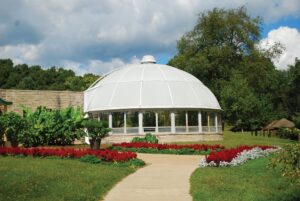
The spacious 755-acre landscape includes rolling hills, forests, meadows, extensive flower, tree, and shrub collections, and as the name implies, a lovely ‘hidden’ lake. Indoor buildings consist of a conservatory housing plants and flowers from three different climates, a Visitors Center, and a Gift Shop. With picnic areas, over 12 miles of hiking trails, and a six mile, one-way scenic paved drive, visitors can enjoy the natural beauty of the property in many different ways. What’s more, there are exciting changes going on at the Gardens, the most significant one being the opening of a Canopy Walk this summer.
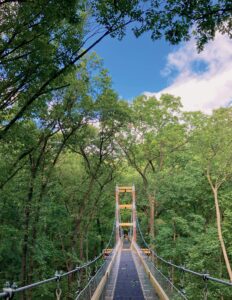
This year is an important one for Hidden Lake Gardens, as it transitions from the slow-down caused by the COVID-19 pandemic to new growth and new opportunities to serve the public. The eagerly anticipated Canopy Walk will allow visitors to walk among the treetops on a 700-foot suspension bridge spanning a glacier-formed valley. The addition of the Canopy Walk will undoubtedly draw more people to the gardens.
According to Jessica Goodrich, the Marketing and Publicity Coordinator of Hidden Lake Gardens, “the Canopy Walk project represents a one-of-a-kind contemporary attraction and will appeal to both residents and travelers, and further, will make Hidden Lake Gardens a destination attraction for people and families who have never visited the Gardens.”
The height of the Canopy Walk will make it possible for visitors to observe their surroundings with a unique perspective, with close-up views of leaves, birds, insects, and other woodland wildlife. In addition, the excitement of walking on a gently swaying bridge, high above the earth, promises to be an exciting and memorable experience for all who take part in it.
“The Canopy Walk attraction has the ability to broaden the traditional pool of visitors to Hidden Lake Gardens who may not have considered a visit before,” Goodrich said. “Trends among other public gardens with canopy walks have shown significant increases in both the number of visitors and memberships.”
Other exciting changes at Hidden Lake Gardens include renovations to the Visitors Center, new restroom fixtures, and a transition to a new website format with more interactive features.
Located in Lenawee County, about 10 miles west of Tecumseh, Hidden Lake Gardens is the result of an intention envisioned by Adrian businessman Harry Fee. Fee bought Hidden Lake and approximately 200 of the surrounding acres when he retired in 1926. In 1945, he donated the land to Michigan State University (then known as Michigan State College) with the wish that the land be used as a natural laboratory to educate and benefit the public.
Fee continued to be active in guiding the expansion of the arboretum until his death in 1955. In the years since his generous donation of land, Hidden Lake Gardens has grown to comprise 755 acres. In addition, several buildings such as the Visitors Center and Conservatory have been added to the property over the years, with the help of other donors, including the Herrick family of Tecumseh.
The vast expanse of land and the huge variety of plants and trees make Hidden Lake Gardens a place that is never the same twice. Although the Canopy Walk is a new and exciting attraction, there are many other features that make this place educational and inspiring.
Throughout the property there are collections of different varieties of trees and plants, labeled and beautifully landscaped. The extensive Harper Collection of Dwarf and Rare Conifers includes several hundred specimens of pines, firs, spruces, larches, hemlocks, and junipers, just to name a few. Hosta Hillside displays numerous varieties of hostas, all growing on a picturesque hillside amidst a cascading stream. The Bonsai Courtyard, open May through October is a peaceful area where visitors can walk around and view different varieties of these unique tiny trees. In addition, there are stunning flower beds and display gardens, showcasing nature’s vibrant artistry.
The Conservatory is made up of three different environments, all with their own distinct plant collections. The Tropical Dome features plants of the tropics such as banana, citrus, and coffee. In the Arid Dome you will find desert plants like aloe and cacti, while the Temperate House showcases seasonal plants like begonias, bougainvillea, and many more. It is especially pleasant to soak in the warmth of the greenhouses on a cold day.
An important part of the mission of Hidden Lake Gardens includes education and community involvement. There are year-round events and classes supporting this vision such as plant sales, an Earth Day celebration, volunteer work days, Fairytale Festival, Moon Walk, and much more. Guided hikes and horticulture presentations are also available throughout the year.
Goodrich believes that with the addition of the new Canopy Walk, there is a chance to appeal to more people and expand educational opportunities.
“The Canopy Walk is a game changer, representing an innovative direction for Hidden Lake Gardens,” Goodrich said. “The project will enable growth in the number of visitors and educational programs the Gardens offer, continuing to fulfill the vision and mission of Michigan State University, Hidden Lake Gardens, and its original founder, Mr. Harry A. Fee.”
The dramatic landscape is part of what makes Hidden Lake Gardens so special. Hidden Lake itself is a natural kettle lake, formed by glaciers thousands of years ago. In addition to the high rolling hills, the property features several glacial kettle holes, oak-hickory forests, open meadows, and wetlands. For those who want to discover the landscape on foot, there are marked hiking trails throughout. A one-way paved driving loop with several scenic lookout points is another option. Each season lends its particular charm to the property, from the lilac blooms and flowering crabapple blossoms of spring, the lush greenery of summer, the vivid colors of fall foliage, to the snow-covered hush of winter.
Paul Pfeifer, Director of Hidden Lake Gardens, sums it up nicely:
“Hidden Lake Gardens is a great place to connect with plants and nature whether you are driving through on Arboretum Road and Woodland Drive; or walking through the Bonsai Courtyard, Conservatory, Dwarf Conifer Collection, and Hosta Hillside; or hiking our woodland trails which will include our new Canopy Walk. Truly a treasure of nature and beauty in the Irish Hills of Lenawee County.”
Though it is conveniently located close to home, when you enter Hidden Lake Gardens, it feels like you are entering a different world. Appealing to horticulture enthusiasts, nature-lovers, and people simply looking for a pleasant day trip with the family, Hidden Lake Gardens is definitely worth visiting. And for many folks, it is worth visiting multiple times to see what has changed, to attend an event, or just to absorb the peace of nature.
As naturalist and writer John Muir puts it: “In every walk with nature one receives far more than he seeks.”
Are you interested in becoming a member? Hidden Lake Gardens members receive many benefits, including free or reduced admission to over 300 public gardens in North America through the AHS Reciprocal Gardens Admission Program and 125 nature centers nationwide through the ANCA Reciprocal Admissions Program. Memberships can be purchased and renewed on our website at HiddenLakeGardens.msu.edu.
Interested in volunteering? Please visit hiddenlakegardens.msu.edu for more details and to submit a volunteer application or call 517-431-2060.
Hidden Lake Gardens is open Tuesdays through Sundays from 9am to 5pm. Gates close at 4:30pm. The Daffodil Gift Shop is open Thursdays through Sundays from 10am to 4pm. The Gardens are located at 6214 Monroe Rd, Tipton, MI 49287. For more information, please call 517-431-2060, email hlg@msu.edu, or visit their website at HiddenLakeGardens.msu.edu.

Previous Events
Hidden Lake Gardens hosts numerous events throughout the year to facilitate the education, enrichment, and enjoyment of nature and the natural landscape of the Gardens. Below are some of the 2023 events. In addition to the list below, keep an eye on the Hidden Lake Gardens’ website, HiddenLakeGardens.msu.edu, and Facebook page for the latest and most up-to-date information.
June 17th – Hosta Leaf Show & Hosta Sale The annual Michigan Hosta Society Hosta Leaf Show and Hosta Sale was hosted at Hidden Lake Gardens.
June 20th – Canopy Walk Opening This highly anticipated event marked the opening of the exciting Canopy Walk through the treetops.
Sept 16th – Run for the Hills! 1 Mile & 5K Run / Walk Participants challenged themselves on the hilliest course in southeast Michigan! All participants received a T-shirt and participation medal.
Sept 17th – The Art of Bonsai A bonsai show returned for the first time since 2019. Event also included a bonsai bazaar with a variety of vendors, demonstrations by highly experienced bonsai artists as well as an introductory presentation on bonsai.
Oct 7th – Hog Warts & Toad Bellies Fairy Tale Festival This fairy tale festival drew families in to enjoy the featured art and craft vendors, local authors, guided nature walks (including Fairies Way and A Knight’s Adventure trail), storytelling and music performances, workshops and classes, a fairy tale picnic and more!
Dec 29th – Under the Silver Moon Walk Guests celebrated light and shadow at our first annual Under the Silver Moon Walk. This magical after-hours event included a trail of luminaries to light the path from the Visitors Center, around the lake, and into the forest to experience our canopy walk in the darkness. All Conservatory biomes were also open to enjoy and explore the beauty within.