NEARLY ONE YEAR AFTER DEVASTATING TORNADO
REBUILDING AND RESILIENCY IN LEROY TOWNSHIP
By Teresa Miller
By Teresa Miller
As we approach the one-year mark since the devastating tornado that tore through Williamston and surrounding areas, the resilience and ongoing efforts to rebuild are a testament to the community coming together in the face of significant losses. The aftermath left an indelible mark on the landscape and the lives of many, particularly in Leroy Township.
On the evening of August 24, 2023, lower west Michigan was hit by severe thunderstorms. These storms were driven by a highly unstable atmosphere and produced two tornadoes.
According to the National Weather Service, the first one was an EF-1 that touched down in west-central Kent County. The second tornado, which started in Williamston and traveled through Webberville, was rated an EF-2 in Ingham County before weakening to an EF-1 in Livingston County.
Besides the tornadoes, the storms brought wind gusts of 60 to 70 mph and intense lightning. This mix of tornadoes, powerful winds, and lightning led to power outages affecting around 460,000 homes and businesses across the state.
Unfortunately, the Williamston area received the brunt of the storm. The tornado touched down at 9:29 p.m. and moved northeast, hitting I-96 and staying on that path for about 1.5 miles before turning southeast. It crossed M-52 south of I-96 and continued south until it entered Livingston County.
With the tornado’s peak wind speed of 125 miles per hour, it caused the most severe damage near and along I-96. Multiple semis and cars were flipped over. Sadly, three people were injured and one man from Grand Rapids lost his life.
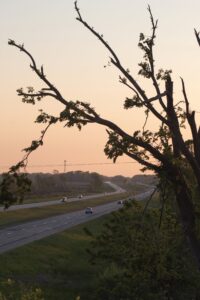
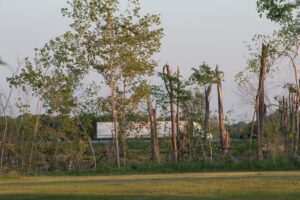
As the tornado ravaged the I-96 corridor it also snapped thousands of trees, damaged several outbuildings, and caused roof, siding, and window damage to nearby homes. A 200 year old Williamston farm, owned by Tim Dietz, was seriously damaged by the tornado. Fortunately no one was severely hurt, but the family lost three barns, farming equipment, crops, cars, and their home.
“There were seven of us in the house at the time,” said Dietz. “Thankfully, there were no injuries to any person, but my daughter’s horses needed stitches.”
According to Leroy Township Supervisor Earl Griffes, rebuilding is taking longer than expected because of the need to find contractors, match new construction to the previous building footprints, and meet present day building codes. Additional obstacles are faced when dealing with insurance companies and getting disaster assistance.
“When FEMA came for a meeting in Webberville, they were very specific about what is covered,” said Griffes. “We were surprised by what was excluded.”
For example, tree damage isn’t covered by insurance unless it impacts an insured structure. FEMA only covers tree damage if it blocks entry to a property. The drain commission handles river and stream cleanup, and the road commission takes care of their property near roads, but landowners are responsible for clearing their own lots.
“Before the storm, you couldn’t see the O’Havlin Court subdivision from the expressway,” said Griffes. “Now, with so many trees down, the houses are visible from I-96.”
Ten months later, Tim Dietz is making progress rebuilding his home and farm. But, because of a significant increase in the cost of construction, he is unable to rebuild the original 2,500 square foot farmhouse. Instead, they’ve downsized their plans to an 1,800 square foot home.
“It’s been a learning curve. We hadn’t had an insurance review since before COVID,” said Dietz. “Also, now that we’ve made a claim, our farmowners insurance has gone up 65%. We are unsure about homeowners because the house is not done yet.”
The slow pace of reconstruction and insurance difficulties, underscores the broader challenges faced by the community. Despite these hurdles, there is a spirit of resilience and adaptation that was apparent the first few days after the storm and continues to today.
Immediately after the storm, Ingham County Commissioner Monica Schafer, representing District 15 in Williamston, coordinated with DTE Energy, Aldi, and Choice Farm Market in Webberville to provide water and meals.
“Many groups and organizations pulled together to help with the cleanup,” said Schafer. “DTE Energy brought water and Aldi brought snacks, and the Webberville Lions and Rotary Club, as well as the Village Council President Brad Hitchcock, rallied people to help. Community members donated gas gift cards and meals through Choice Farm Market, which collaborated with the schools to help those most affected.”
Choice Farm Market also had a backup generator to help provide power during the cleanup effort. Having come through this experience, Leroy Township has funded the installation of a backup 3-phase generator at the township hall.
“This will allow the township to serve as a shelter and staging area,” said Griffes. “We’ll be able to provide water and electricity during future storms or power outages.”
The situation in Leroy Township highlights how people need to take action as well as obtain support from systems in place to recover from such natural disasters. Being in a vulnerable position after an event like a tornado is made easier when others lend a hand.
“The community really came together after the storm,” said Dietz. “The Williamston Free Methodist Church family came out and Coach Steve Kersten rallied the football team to help with the cleanup. And, my coworkers from Bayer brought us food.”
Rebuilding is not without challenges, from navigating insurance complexities to adjusting to new realities. Yet, the collaborative efforts of local leaders, businesses, and residents have set a foundation to not just replace what was lost but also to prepare for future disasters. As we reflect on the events and the recovery efforts, it’s clear that the true strength of Williamston lies in its people — a community unbowed by the storm, moving forward together, stronger than before.